
In an industry where growth opportunities continue to expand, the companies that invest in the systems that support their operations are the ones best positioned to scale.
By Dan Greer
Growth is exciting in the waste industry. More routes. More vehicles. More drivers. Bigger contracts. Stronger revenue. It feels like momentum. It feels like winning. Until growth starts charging interest. Not in dollars, but in exposure.
One more truck means one more set of files that must be right. One more driver means one more medical card that can expire quietly. One more route means one more chance for a small miss to become a big problem. If you have ever opened a letter from a regulator or an insurance auditor, you know exactly what I am talking about. It is the kind of moment where the office suddenly gets very quiet and someone says, “Okay… nobody panic.”
Here is the uncomfortable truth most growing companies eventually run into: growth does not just multiply revenue, it also multiplies risk. Most waste operators are not struggling because they lack discipline. The people in this industry work hard and care deeply about doing things right. The problem is usually much simpler.
The systems that worked great when the company had four or five vehicles suddenly start groaning when the fleet grows to 30 or 40. The spreadsheets get bigger, the files get thicker, and the margin for error gets smaller. Which leads to the real question companies eventually have to answer: not “Can we grow?” Most companies can. The real question is: “Can your systems grow with you?”
Growth Exposes Your System—Not Your People
When something falls through the cracks, leadership often blames people. Someone forgot to pull a motor vehicle record (MVR). Someone did not update a maintenance record. Someone missed an expiration date. However, most of the time, it is not a people problem. It is a system problem. Manual tracking works beautifully—right up until it does not.
At eight vehicles, you can keep things in a spreadsheet. At 15, you start color-coding cells. At 25, someone creates a second spreadsheet “just to be safe.” At 40, nobody trusts any of them. Now you have got files in a cabinet, some documents scanned, some in e-mail, and some “on Jim’s computer.” Everyone believes it is handled—until you actually need it. That is when the scramble begins.
The stress you feel during growth is not because you hired the wrong people. It is because your infrastructure has not caught up to your ambition. Every vehicle you add increases:
• Driver qualification documentation
• Drug and alcohol tracking
• MVR monitoring
• Maintenance recordkeeping
• Expiration management
• Regulatory visibility
That risk does not grow linearly. It compounds. And if your system depends heavily on memory, calendar reminders, and one really responsible office manager, growth will eventually overwhelm it. Here is a simple test: if adding vehicles increases your anxiety, your system is too dependent on you. The right system should absorb growth. The wrong system makes you feel it.
The Three Systems Waste Companies Grow Under
When waste companies scale, they do not usually sit down and formally choose a system. They just keep doing what they have been doing. But whether intentional or not, every growing operation ends up under one of three types of systems—and the system you operate under determines whether growth feels controlled or chaotic.
Path One: The Manual System (Works … Until It Does Not)
This is the most common path. Spreadsheets. File cabinets. Shared drives. Calendar reminders. And one or two trusted people who “know where everything is.” There is nothing wrong with this approach at small scale. In fact, it often works well in the early years. It feels inexpensive, familiar, and controlled.
However, there is the catch: manual systems demand more from you as you grow. There is more checking, verifying, reminding, and follow up. They rely heavily on human consistency—and humans are busy. As your business grows, so does:
• The number of expiring medical cards
• The number of MVR pulls required
• The volume of maintenance documentation
• The number of training records to track
• The chance that something gets missed
The stress does not show up all at once. It creeps in. You start double-checking more. You start asking, “Are we sure that’s done?” You start hoping nothing arrives in the mail. Manual systems do not fail because people are careless. These systems fail because they were not built to scale.
Path Two: The Structured Digital System
As waste operations grow, many companies reach a point where spreadsheets and file cabinets simply cannot keep up. What worked at three or four vehicles starts breaking down at eight or nine. By the time a company reaches 20 or 50 vehicles, documentation is often scattered across shared drives, inboxes, paper folders, and multiple tracking sheets.
That is when many operators make an important shift: they move from manual tracking to a centralized digital system. Driver files live in one place. Expiration dates trigger alerts. Maintenance documentation becomes visible. Records are structured, searchable, and easier to retrieve. The biggest difference is visibility.
Instead of wondering whether something has been updated, leadership can see it. Instead of scrambling before an audit, documentation can be produced quickly and confidently. Rather than reacting to problems after they occur, teams begin to operate proactively. Across industries that rely on vehicles—including waste management, utilities, construction, and energy—many organizations are adopting specialized compliance platforms to manage this complexity. Systems like DOTDocs.com, for example, were developed specifically to help companies that use vehicles keep driver files, maintenance records, and regulatory documentation organized and audit-ready in one place.
For many waste companies, this shift is less about technology and more about removing friction from daily operations. Leaders want their teams focused on routes, equipment uptime, and customer service—not digging through file cabinets or chasing paperwork. Structured systems help remove that friction. They reduce guesswork, improve documentation accuracy, and create operational visibility.
However, even the best systems still require ownership. Someone on the team must monitor alerts, correct deficiencies, upload documentation, and maintain accuracy over time. In other words, organized systems remove chaos. They do not remove responsibility. And as operations continue to expand, many companies begin looking for ways to strengthen that oversight even further.
Path Three: The Supported System
At a certain point, even well-organized digital systems reach their limits. The files are centralized. The alerts are working. The documentation is structured. However, someone still must monitor everything, respond to alerts, correct deficiencies, and keep the system current.
In a growing waste operation, that responsibility often ends up landing on someone who already has three other jobs. Because let’s be honest, nobody really knows where compliance belongs. Some say HR, some say fleet, some say safety. The truth is that compliance is all of those and more.
This is where a third model has begun gaining traction across industries that rely heavily on vehicle fleets: the supported or managed compliance model. Instead of simply using software tools, companies partner with specialists who actively monitor and maintain their regulatory infrastructure. Files are reviewed, deficiencies are flagged, audit readiness is continuously monitored, and documentation is maintained on an ongoing basis. Leadership is no longer tracking expiration dates—they are leading.
- The shift many operators discover is that the real benefit is not just organization, it is also reclaimed bandwidth. When oversight is built into the system:
- Stress drops
- Decision-making improves
- Growth feels controlled instead of chaotic
- Time returns to the people who should be focused on operations, customers, and expansion
Across the waste industry and other sectors that rely on vehicles, some companies now work with managed compliance teams—organizations that provide ongoing monitoring and regulatory support. At first glance, this model can appear more expensive than handling compliance internally. But when operators look at the full picture, the math often changes.
Building an internal team of compliance experts who focus on driver files, regulatory changes, audits, and documentation all day would be costly for most organizations. Partnering with a specialized team allows companies to access that expertise at a fraction of the cost of hiring and maintaining a full internal department, or even one person with no experience. More importantly, it significantly reduces risk.
The reality is simple: when regulatory oversight becomes someone’s full-time focus, things tend to get caught earlier, corrected faster, and documented properly. In an industry where operational margins, insurance exposure, and regulatory scrutiny continue to increase, that kind of oversight can make a measurable difference. The most scalable waste companies do not just add vehicles, they also upgrade the systems supporting those vehicles because the goal is not just growth, it is also sustainable growth.
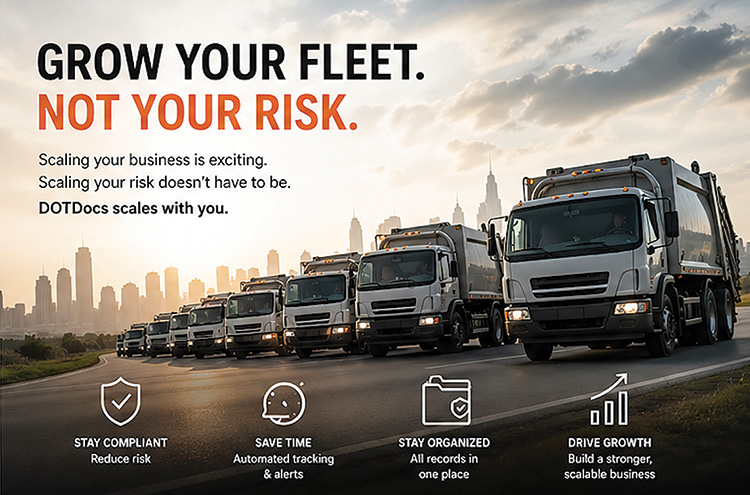
operational foundation of the company. Image courtesy of EclipseDOT.
The True Cost of Scaling Without Structure
A lot of folks in operations look at systems as an expense line. Software costs money. → Outside oversight costs money → Upgrading infrastructure costs money. What rarely gets calculated is the cost of not upgrading.
The real cost of scaling without structure does not show up on a monthly invoice. It shows up quietly. Let’s challenge that thinking for a moment. Where would this country be if businesses had decided that investing in growth was simply too expensive? Imagine the U.S. without infrastructure. No highways or power grid. No running water in most homes. Just two-track dirt roads and a lot of hard work trying to get from one place to another.
The things we depend on today exist because someone was willing to invest in building them. Infrastructure requires investment. The same principle applies inside every business. The systems that support growth may cost money today—but the cost of not building them almost always shows up later, and usually when it hurts the most.
Insurance Premiums
One preventable violation. One crash with incomplete documentation. One review where your files do not match your story. Insurance carriers do not just look at accidents, they also look at patterns—documentation integrity, safety practices, and operational discipline. Premiums respond accordingly. What feels like saving money on systems can quietly turn into six figures over a few renewal cycles.
Fines and Corrective Action
Regulators do not care that the company was busy growing. They care that documentation is accurate and accessible. If it takes two days, three inbox searches, four phone calls, and someone saying, “I swear we had that,” to produce documentation, that is not just inconvenient. That is operational chaos hiding behind revenue growth. And when deficiencies stack up, corrective action plans consume something even more valuable than money: time and focus.
Lost Contracts
Municipalities and large private contracts increasingly evaluate safety records and operational discipline. If safety scores slip or documentation raises questions, opportunities disappear quickly. You can have the best pricing in the room, but if your infrastructure raises concerns, you are negotiating from behind before the conversation even begins.
Internal Burnout
This cost rarely appears on a spreadsheet. Owners spend evenings reviewing files. Office managers carry constant pressure. Operations leaders become compliance chasers instead of performance drivers. When systems work against the team, growth starts to feel heavier than it should. Over time, that weight erodes morale and culture.
The Leadership Tax
The most expensive cost leaders overlook is attention. Every hour spent checking expiration dates is an hour not spent expanding routes, strengthening relationships, improving safety culture, recruiting great drivers, or building the business. Growth requires focus. If your system demands more attention as the company scales, it is not supporting leadership—it is taxing it. And leadership bandwidth is finite.
Growing Support Systems
When the infrastructure is right, compliance stops being a daily stress point and starts becoming part of the operational foundation of the company. Systems create capacity. Think of it this way. If you try to run a million gallons of water through a garden hose, it is going to take a very long time. However, if you upgrade that hose to a 48-inch pipe, suddenly that same million gallons moves through without much resistance at all. The water did not change. The pipe did. The same principle applies inside growing companies.
If you want to grow the size of your business, you must grow the systems that support it. And sometimes that means bringing experts into your team who have already solved these problems before. Because here is the truth most leaders eventually discover: trying to figure it all out yourself is expensive. Not just in dollars, but in mistakes, downtime, stress, and missed opportunities.
When the right systems are in place and the right expertise is supporting them, growth becomes smoother, safer, and far more predictable. Which brings us back to the real choice every growing operation eventually faces—you can keep pushing growth through systems that were designed for a much smaller company, or you can spend a little money upfront and upgrade the infrastructure that supports that growth. One path creates constant friction. The other creates capacity.
In an industry where growth opportunities continue to expand, the companies that invest in the systems that support their operations are the ones best positioned to scale. Because at the end of the day, compliance is not just paperwork, it is also infrastructure—and this is what makes growth possible. | WA
Case Study: Systems Allow Growth
EclipseDOT worked with a company in the waste industry that went through a situation many operators eventually face. They were using one of the big-name compliance systems in the industry. The kind most people recognize. Then they acquired a smaller company. That smaller company happened to be using DOTDocs through EclipseDOT. During the transition, the owner of the acquired company told them something simple: “You guys should really take a look at this.” So, they did.
They walked through the system, saw how the files were organized, how documentation was monitored, and how oversight was handled. They made the switch. Since then, they have acquired five additional companies. And the interesting part? Compliance is no longer something they worry about. It is handled.
Dan Greer is the Founder of Eclipse DOT and creator of the DOT Docs system, helping companies that operate vehicles build stronger compliance and operational systems. With more than 20 years of experience in transportation operations and fleet safety, Dan works with organizations across North America to simplify regulatory requirements and scale safely. He is the author of Grit, Grease, and Grace: Leadership Forged in the Trenches, host of the Forged with Dan Greer podcast, and travels across the country speaking on leadership, safety culture, DOT, and business growth. Dan also holds leadership and training events for companies across multiple industries. You can follow him on any platform @RealDanGreer. For more information, visit https://eclipsedot.com.