
Shredding deserves a more strategic role in modern waste and recycling facilities. Rethinking its purpose could unlock significant operational, financial, and environmental gains.
By Luis Martins
In many waste and recycling plants, shredding is still viewed as a necessary first step—a box to check before the “real work” begins. It is often specified late in the design process, selected on throughput or upfront cost, and treated as a standalone machine rather than an integrated part of the system. But that approach is problematic.
As facilities invest in automation, AI-driven sorting, and more advanced recovery systems, the role of shredding has evolved. Where once it was simply viewed as size reduction technology, it is increasingly about conditioning material in a way that determines how effectively everything downstream can operate. In other words, shredding is the key control point.
Where Performance Begins
At a plant level, shredding has its greatest impact on material consistency and overall system stability. When material is uniformly sized and properly conditioned, downstream technologies perform optimally—screens separate more accurately, optical sorters identify materials with greater precision, and robots can pick faster and more reliably.
This becomes even more critical as facilities adopt AI and real-time data systems are designed to analyze and optimize material streams. These technologies rely on predictable inputs. Without consistent material presentation, their effectiveness is fundamentally limited.
On the other hand, inconsistent shredding introduces variability that can spread throughout the entire process. What starts as uneven particle size or poorly conditioned material can soon translate into inefficiencies across sorting, separation, and recovery. Although shredding sits at the front of the line, its role extends all the way to final product quality and recovery rates.
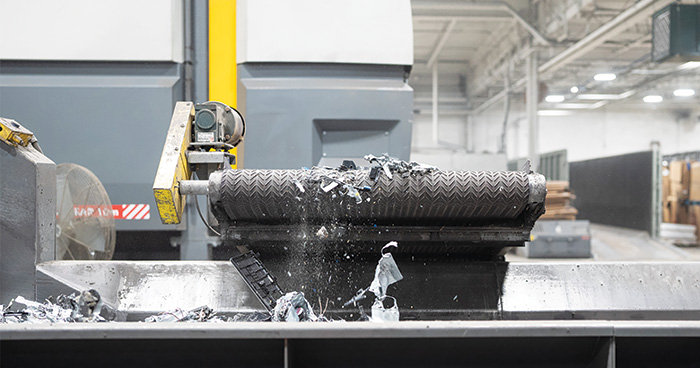
Photo courtesy of UNTHA America.
The Hidden Cause of Underperformance
When downstream systems fail to meet expectations—whether through poor recovery rates, contamination, or unstable throughput—the root cause is often traced back upstream. In many cases, inconsistent or poorly controlled material conditioning is a significant contributor.
The challenge is that these issues rarely present themselves clearly. External factors such as moisture content or seasonal conditions can mask the true source of the problem. As a result, operators may focus on adjusting downstream equipment, when the real limitation lies in how the material was prepared in the first place.
Common Mistakes in Shredder Investment
One of the most frequent errors operators make is treating the shredder as a standalone asset rather than part of an integrated system. This often leads to a mismatch between shredding output and downstream requirements. Beyond that, several other issues tend to arise:
• Prioritizing upfront cost over lifecycle performance
• Oversimplifying the variability of the material stream
• Underestimating wear, maintenance, and uptime considerations.
These decisions may reduce initial capital expenditure, but they often result in higher operational costs and reduced overall efficiency.
What “Bad Shredding” Can Look Like
Poor shredding approaches are rarely defined by one single failure. Instead, they come from a series of smaller errors that accumulate over time.
• A wide and inconsistent particle size distribution
• Long, stringy materials—particularly films
• Oversized items mixed with excessive fines
• Fluctuating and unpredictable throughput
Individually, these issues might seem manageable, but collectively, they can significantly degrade system performance.
The Cost of Getting it Wrong
When shredding is not done properly, the consequences are not limited to within the shredder itself. Operationally, facilities may experience increased downtime, greater wear on downstream equipment, and higher labor demands. Financially, it could mean lower recovery rates, reduced commodity value, and elevated maintenance costs. Environmentally, the stakes are equally high. Poor material conditioning can result in more waste being sent to landfill and higher energy consumption per ton processed.
And, while these costs are rarely visible in the initial equipment quote, they show up across the entire operation.
Shredding in an Age of AI and Automation
As the industry continues to embrace automation and artificial intelligence, the importance of consistent input material is huge. AI systems are designed to operate within defined parameters. When material size, shape, and presentation fall outside those parameters, performance drops—sometimes significantly. Advanced technologies can adapt to a degree, but they cannot fully compensate for poor upstream processing.
A Change in Plant Design Thinking
Compared to five or 10 years ago, there is a noticeable shift toward more integrated, system-level design. Historically, shredders were added as standalone units. Today, more operators recognize the importance of aligning shredding with downstream processes from the outset—particularly as automation and real-time analytics become more common.
This change points to a broader understanding that performance is not determined by individual machines, but by how well the entire system works as a whole.
Enabling Recovery and the Circular Economy
Effective shredding plays a direct role in improving recovery rates and reducing landfill dependency. By producing a more uniform and predictable material stream, it enhances sorting efficiency and material purity. This, in turn, increases the volume of material that can be recovered as a usable product.
Making the Business Case
In an increasingly cost-focused business landscape—where so many business decisions come down to the bottom line—the case for investing in proper shredding is stronger than ever.
Operators are under growing pressure to maximize uptime, reduce labor costs, and improve recovery rates—a well-designed shredding solution addresses all three. When evaluated around the total cost of ownership—rather than initial purchase price—the return on investment is often compelling.
If there is one myth the industry needs to bust once and for all, it is that shredding is just about size reduction. Really, it is about material conditioning for the entire system. That distinction matters, because it reframes shredding from a basic function to a strategic control point—one that defines the performance potential of everything that follows afterwards.
So, What Does “Good” Look Like?
In a future-ready facility, shredding should be seen as a deliberate and engineered foundation. An effective system is consistent, predictable, integrated, efficient, and safe. And for an industry striving to improve efficiency, maximize recovery, and reduce environmental impact, that clarity has never been more important. | WA
Luis Martins is VP of sales at UNTHA America. He can be reached at (413) 244 8832, e-mail [email protected], or visit www.untha-america.com.