
How smart operators are turning the largest landfill category into a revenue engine.
By Samuele Barrili
Let me tell you a story that should make every waste company owner in America uncomfortable. A mid-sized hauler I worked with in the Southeast was collecting food waste from 14 restaurant accounts and a regional grocery chain. Every week, roughly 40 tons of organic material went straight into the compactor, mixed with general MSW, and got buried in a lined cell at the local landfill. The tipping fees alone were running north of $60 per ton. The methane liability was building invisibly underground. And the phone calls from the municipality about odor complaints were becoming a monthly ritual. That operator was paying to destroy value.
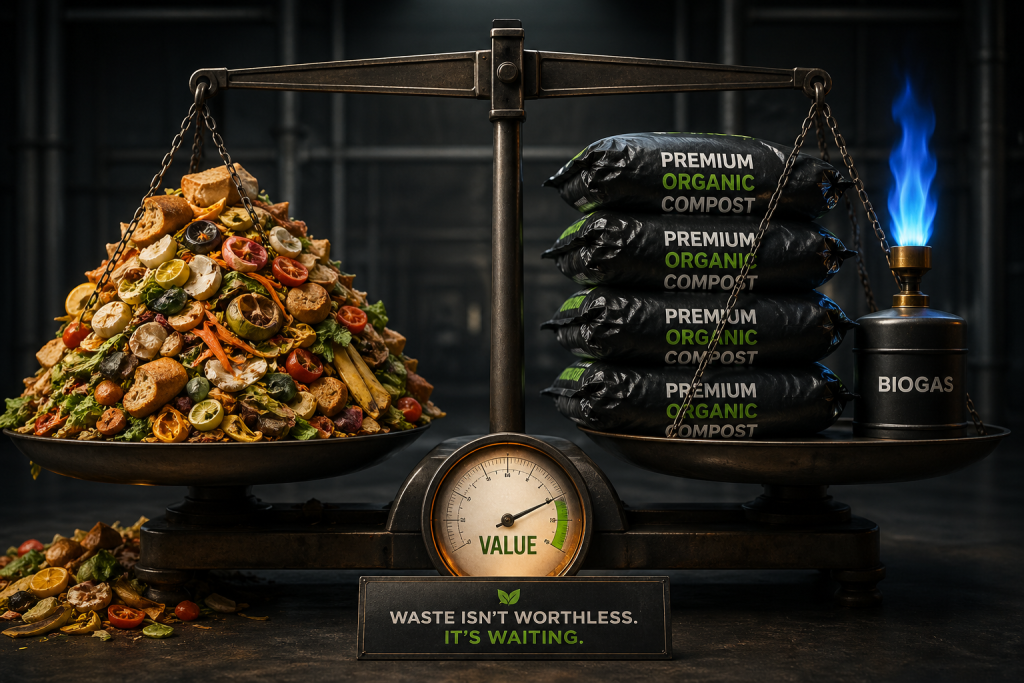
Forty tons per week of organic material that contained recoverable nutrients, convertible energy, and marketable soil amendment products—all of it getting crushed, buried, and forgotten. Meanwhile, landscaping companies in the same county were importing bagged compost from three states away. Local farms were spending thousands on synthetic fertilizers and a biogas developer 20 miles down the road was actively looking for feedstock. The waste was not the problem. The business model was the problem.
Twelve months later, that same operator had restructured: a dedicated organics collection route, a partnership with a regional composting facility, an offtake agreement for finished compost sold to three landscaping distributors, and a second revenue line from a co-digestion arrangement with the nearby anaerobic digestion plant. The food waste that used to cost money to bury was now generating revenue from two directions: processing fees from generators who needed compliant diversion, and product sales from the materials that came out the other end.
This is not an isolated success story. This is the beginning of a structural shift in the American waste industry. And operators who do not understand what is happening will find themselves on the wrong side of it.
The Scale of the Opportunity No One Wants to Talk About
The numbers around food waste in the U.S. are staggering, and they have only gotten worse since the last time most operators bothered to look. According to the most recent data from ReFED, surplus food in the U.S. rebounded to approximately 73.9 million tons in 2023, representing about 31 percent of the total food supply and carrying an economic value estimated at $382 billion. The EPA updated its consumer cost estimates in 2025, finding that a family of four now loses nearly $3,000 a year to uneaten food—almost double the commonly cited $1,500 figure that was based on 2010 price data.
Food remains the single largest category of material entering American landfills. It accounts for roughly 24 percent of what gets buried. And when it decomposes anaerobically underground, it produces methane—a greenhouse gas approximately 80 times more potent than carbon dioxide over a 20-year horizon. Here is the part that matters most to you as a business operator—all of that buried organic material is feedstock. It is nutrient-dense, energy-rich, and increasingly regulated in ways that create mandatory demand for diversion services.
The global food waste recycling market was valued at approximately $77.6 billion in 2024 and is projected to reach more than $132 billion by 2034. The anaerobic digestion market alone hit $17.28 billion in 2024 and is growing at roughly 11.5 percent annually. These are not abstract projections from consultants trying to sell you a dream. These are capital flows following regulatory certainty and material economics. If you run a waste company and you are not thinking seriously about organics, you are leaving an enormous revenue category on the table while your competitors build the infrastructure to capture it.
The Regulatory Wave That Changes Everything
For years, organic waste diversion was a talking point—something progressive states experimented with while the rest of the country shrugged. That era is finished. As of early 2026, 12 states have enacted organic waste bans of varying scope, and more than 30 states introduced nearly 100 food waste-related bills in a single legislative year. The trajectory is unmistakable. States are moving from voluntary recycling encouragement to mandatory diversion with enforceable deadlines and reporting requirements.
Consider what has happened just in the past two years. California’s SB 1383 enforcement has intensified, with 94 percent of communities now operating residential organics collection programs. New York expanded its food donation and food scraps recycling law in 2026, lowering the threshold from 2 tons per week to 1 ton per week for commercial generators within 25 miles of an organics recycler—and the threshold drops again to half a ton per week in 2028. Connecticut’s commercial organics recycling requirement kicks in mid-2026 for entities generating 26 tons or more per year. Maryland now requires diversion for businesses producing 1 ton or more per week. Maine passed its food waste ban in 2025, becoming the last New England state to do so. Washington’s phased commercial ban continues to ratchet down, with the 2026 threshold now reaching any business generating more than 96 gallons of organic waste per week.
Massachusetts, Rhode Island, Vermont, New Hampshire, and the District of Columbia already have commercial bans in place. Vermont enforces a full ban covering both commercial and residential generators. And this is not just a coastal phenomenon. Cities and counties in Florida, Minnesota, Texas, Colorado, and Oregon have enacted local bans that are pulling the interior of the country into the same regulatory logic.
What does this mean for you as a waste operator? It means your commercial accounts—supermarkets, restaurants, hotels, hospitals, universities, food processors—are being told by law that they cannot put their food waste in your regular collection stream anymore. They need a compliant diversion pathway. And someone must provide it. That someone should be you.
Three Opportunity Areas That Turn Organics into Revenue
When I advise waste companies on building an organics strategy, I frame the opportunity around three core pathways. Each one can stand alone, but the real margin lives in combining them intelligently based on your geography, your existing routes, and the downstream infrastructure available to you.
#1: Compost Production: The Simplest Entry Point with the Fastest Payback
Composting is the lowest-capital entry into food waste valorization. It does not require the heavy engineering or process chemistry of anaerobic digestion. It does not demand sophisticated gas-handling systems. What it demands is operational discipline, contamination control, and market development for the finished product.
A well-run composting operation produces a stable, pathogen-free soil amendment that commands real money in the marketplace. Finished compost can sell for anywhere from $30 to $80 per cubic yard depending on quality, certification, and regional demand. Specialty blends and bagged retail products push margins even higher. In California, where SB 1383 requires jurisdictions to procure recycled organic products, demand for quality compost is currently outstripping supply in some regions.
The revenue model works from both directions. On the intake side, you charge generators a processing fee for accepting their source-separated organics—typically at a discount to landfill tipping fees, which makes you competitive while still generating revenue. On the output side, you sell the finished compost to landscapers, nurseries, farms, municipalities, and retail channels.
The operators who do this well are not just running a pile of decomposing food in a field. They are managing feedstock ratios, monitoring temperature and moisture, controlling odor through proper aeration, and testing their finished product to meet quality standards for which buyers will pay a premium. The difference between commodity compost and premium compost is operational discipline—and it shows up directly on the margin line.
#2: Anaerobic Digestion and Biogas: Where Energy Meets Material Recovery
Anaerobic digestion is the higher-capital, higher-return pathway. It converts organic waste into biogas—a mixture of methane and carbon dioxide—under controlled anaerobic conditions. That biogas can be used to generate electricity, upgraded to renewable natural gas for pipeline injection, or converted into vehicle fuel. The solid residue, called digestate, retains most of the nutrients from the original feedstock and can be further processed into biofertilizer or compost.
The economics of AD have improved significantly in recent years. Federal incentives, including the Section 48 Investment Tax Credit, have provided favorable treatment for biogas projects.
State-level renewable energy credits and low-carbon fuel standards—particularly in California—add additional revenue layers. The growing demand for renewable natural gas from utilities, data centers, and fleet operators is creating long-term offtake opportunities that make project financing more attractive.
The American Biogas Council has projected continued strong growth for the sector, and multiple major waste companies—Republic Services, Waste Management, and others—are investing in digestion capacity. However, the real opportunity for smaller and mid-sized operators is not necessarily in building their own digester; it is in becoming a reliable feedstock supplier to existing or planned AD facilities through co-digestion partnerships.
Many water resource recovery facilities and agricultural digesters are actively seeking organic co-digestion feedstock because food waste dramatically increases biogas yields compared to processing sewage sludge or manure alone. If you control a consistent, source-separated stream of food waste, you become a strategic supplier—and you get paid for delivering feedstock that someone else turns into energy.
#3: Biofertilizer and Specialty Products: The Premium Output Strategy
The third pathway is about what comes out the other end of your processing operation—and how you position it in the market. Digestate from anaerobic digestion, when properly processed and stabilized, can be marketed as organic biofertilizer. It contains nitrogen, phosphorus, potassium, and micronutrients that crops need. In a market where synthetic fertilizer prices have been volatile and where demand for organic-certified inputs continues to grow, biofertilizer is not a waste product. It is a product.
Compost-based specialty blends—custom soil mixes for landscaping, turf management, urban agriculture, and erosion control—can command $50 to more than $500 per ton depending on formulation and market. Pelletized fertilizer products made from processed digestate open up distribution channels that bulk compost cannot reach.
The key insight here is that your output is only worth what the market will pay for it, and the market pays for consistency, certification, and convenience. If you produce a variable, uncontrolled output with unknown nutrient content and no quality assurance, you are selling a commodity—or worse, you are paying someone to take it off your hands. If you produce a tested, certified, consistently formulated product with clear application guidelines, you are selling a premium input that farmers and landscapers will come back for.
This is where the secondary raw materials mindset becomes critical. You are not managing waste. You are manufacturing a product from a secondary feedstock. Every decision you make—from contamination control at intake to processing parameters to packaging and distribution—should reflect that.
Partnership Models That Accelerate the Transition
You do not have to do all this alone, and in most cases you should not try. The smartest operators build their organics strategy around partnerships that reduce capital exposure, secure feedstock, and create guaranteed outlets for their products:
• Supermarket and grocery chain partnerships: Large retailers are under increasing regulatory and reputational pressure to divert food waste. Many of them will pay a premium for a hauler who offers a dedicated organics pickup with documented diversion reporting. If you can offer a turnkey program—collection, transport, processing, and a compliance report—you become embedded in their operations in a way that generic haulers cannot match.
• Restaurant and food service agreements: Restaurants generate highly consistent organic waste streams with predictable volumes. Source-separation programs at the kitchen level, supported by simple training and proper container placement, can deliver clean feedstock that commands better processing terms. Multi-location food service operators are especially attractive because one contract covers multiple pickup points.
• Municipal diversion programs: As cities and counties face mandated diversion targets, many of them lack the collection infrastructure and processing capacity to comply. A private hauler that can offer a permitted processing pathway and documented diversion tonnage is solving a compliance problem for the municipality—and that makes the contract stickier and more valuable than a standard collection agreement.
• Agricultural and landscaping offtake agreements: Secure your output markets before you scale your input. A signed offtake agreement with a regional landscaping distributor, a farm cooperative, or a nursery chain gives your processing operation financial predictability and reduces the risk of producing material you cannot sell.
• Co-digestion arrangements with wastewater facilities: Many publicly owned treatment works are exploring or already accepting food waste as a co-digestion feedstock. If you can deliver clean, source-separated organics to a facility that has spare digestion capacity, you may negotiate favorable tipping rates while the facility benefits from increased biogas production and potential energy revenue. This is a relationship where both sides win.
The Challenges Are Real—And Manageable
I am not going to pretend that building an organics line of business is simple. The challenges are real, and operators who ignore them will fail:
• Contamination is the number one killer: Source-separated organics are only valuable if they are separated. Plastic bags, packaging, glass, and non-organic materials in the feedstock degrade your compost quality, damage digester equipment, and can render your output unmarketable. Contamination control starts at the generator level with education, proper containers, and clear expectations—and it continues through every step of your collection and processing chain. Invest in this. It is not optional.
• Logistics require dedicated planning: Food waste is heavy, wet, and odorous. It cannot sit for a week in a dumpster the way dry recyclables can. Collection frequency, route density, and transfer and staging logistics matter. If you try to bolt organics onto your existing MSW routes without dedicated planning, you will create operational chaos and customer complaints.
• Processing capacity is still being built: In many regions, the infrastructure to process food waste—whether composting facilities, digesters, or depackaging operations—is not yet adequate to handle the volumes that new regulations are pushing out of landfills. That is simultaneously a challenge and an opportunity. If processing capacity in your market is limited, you may be in a position to develop it—and capture the margin that comes with controlling both the collection and processing sides of the value chain.
• Education is ongoing: Your generators, drivers, processing staff, and sales team all need to understand what you are building and why it matters. Organics is not just another waste stream. It is a different operational discipline with different quality requirements, different handling protocols, and different revenue dynamics. If your team does not understand the business model, they cannot execute it.
What this Looks Like When it Works
I want to bring this back to the operator I described at the beginning. Within the first year of restructuring, the organics program was handling approximately 50 tons per week of source-separated food waste across 22 commercial accounts. The dedicated collection route was running five days a week with a single rear-load truck modified for organics.
The processing partnership with the regional composting facility gave the operator a tipping fee approximately 30 percent below the local landfill rate—which became a competitive advantage when bidding for new food-waste-generating accounts. The finished compost was sold under a co-branded label to three landscape supply distributors and one regional nursery chain. The co-digestion arrangement with the nearby AD plant generated a second revenue line: the plant paid a modest feedstock fee for the cleanest fraction of the organic stream, which it blended with dairy manure to increase biogas yields.
In total, the operator replaced what had been a cost center—paying landfill tipping fees on 40 tons of mixed organics—with a dual-revenue model that generated income from both the intake side (processing and diversion fees from generators) and the output side (compost sales and feedstock payments from the digester).
The margins on the organics line were not extraordinary in year one. However, they were positive, growing, and—most importantly—they locked the operator into a regulatory-driven market that competitors had not yet entered. By the time nearby haulers started asking how to comply with the new state organics mandate, this operator already had the routes, the relationships, and the processing agreements in place. That is what first-mover advantage looks like in a regulated market.
The Reframe: Stop Thinking Like a Hauler, Start Thinking Like a Resource Company
Here is the fundamental mental shift that separates operators who will thrive in the next decade from those who will struggle. The traditional waste business model is simple: pick it up, take it away, bury it, charge a fee. That model works until the material you are burying becomes regulated, the landfill raises its rates, the municipality demands diversion metrics, and your customers start shopping for operators who offer something more sophisticated.
The resource company model is different. You do not just move material. You control the stream. You understand what is in it. You separate it intelligently. You route each fraction to its highest-value destination. And you capture revenue not just from the act of collection, but also from the economic value of the outputs that you produce.
Food waste is also the most accessible, most abundant, most regulation-driven entry point into this model. It does not require exotic technology. It does not require massive capital. What it requires is a willingness to look at the material differently—to see it not as something to be disposed of, but as a feedstock with recoverable value and a market that is being built around you whether you participate or not.
The operators who master organics will not just meet landfill bans, they will also own a new market category. They will have sticky commercial relationships with generators who need compliant diversion. They will have product lines that generate revenue long after the truck has left the route. And they will have a strategic position that is far harder to compete away than a simple hauling contract. The question is not whether this shift is coming—it is already here. The question is whether you are going to lead it or react to it. | WA
Samuele “Sam” Barrili is the founder of Waste and Landfill Recycling (WLR) and the author of The Waste Alchemy. Known in the industry as “The Waste Management Alchemist,” Sam helps waste companies, recyclers, haulers, and landfill owners transform their operations by applying the SAM Method—Stream Advanced Management—to unlock hidden value in the material flows they already control. With more than 15 years in the waste sector and an international practice spanning Europe, the U.S., and Africa, Sam specializes in secondary raw materials strategy, business model transformation, and commercial positioning for operators ready to move beyond traditional disposal thinking. Get your copy of The Waste Alchemy at https://bit.ly/4sQt4LQ. Book a free 20-minute consultation at https://sambarrili.com/schedule-free-20min-call.