
Fiber reinforcement strengthens concrete from within, improving its ability to resist cracking, absorb impact and withstand harsh environmental conditions. When combined with the right design practices and construction techniques, it creates more resilient, longer-lasting floors.
Chris French
Waste handling and processing facilities place extreme demands on flooring systems. From transfer stations and recycling centers to waste-to-energy plants, these environments subject concrete slabs to constant traffic from loaders and trucks, abrasive material streams, chemical exposure, and repeated impact events. Without a properly engineered system, these floors deteriorate quickly, leading to costly repairs, operational disruptions, and safety concerns.
For facility designers, contractors, and operators, the challenge is not simply selecting materials, but also developing a flooring system that performs reliably under these conditions. One increasingly effective approach is integrating fiber reinforcement within the concrete substrate, then sealing with high-performance surface protection systems. When properly done, this approach improves durability, reduces maintenance, and extends service life in high-demand waste environments.
Reinforcing Concrete at the Microstructural Level
Concrete is inherently strong in compression but relatively weak in tension, making it susceptible to cracking from shrinkage, thermal movement, and dynamic loading. These cracks can often propagate to the surface, compromising both structural integrity and long-term performance.
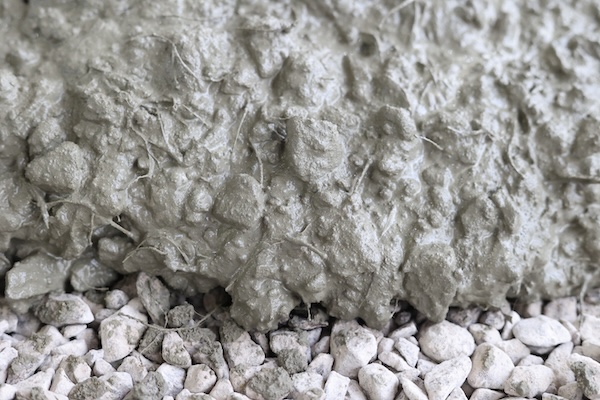
Fiber reinforcement addresses this limitation by distributing tensile resistance throughout the concrete matrix. Unlike traditional reinforcement like rebar or wire mesh, fibers are uniformly dispersed, offering multidirectional support that improves crack control and post-crack behavior.
Microfibers, typically polypropylene, are used at low dosages to control plastic shrinkage in early curing by reducing surface tension and mitigating capillary stresses. By limiting the formation of fine surface cracks, they reduce defects that can later expand under service conditions.
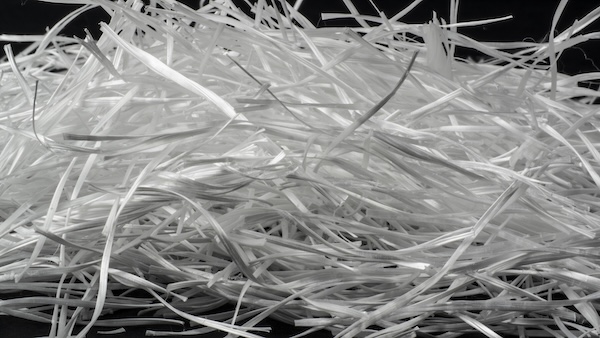
Macrofibers, either synthetic or steel, provide structural benefits by improving load capacity, impact resistance, and overall toughness. Synthetic macrofibers, commonly used at dosages of 3 to 8 pounds per cubic yard, offer corrosion resistance. This is an important advantage in waste facility environments, where substantial moisture and aggressive chemicals are present.
Controlling Shrinkage to Extend Floor Performance
Shrinkage is a top cause behind concrete floor failures. As concrete cures and loses moisture, it contracts. When that movement is restrained, tensile stresses develop and cracking occurs. Even small cracks can have significant consequences in waste environments. They create pathways for moisture infiltration, chemical attack and freeze–thaw damage, all of which accelerate deterioration over time. In facilities exposed to leachates, cleaning solutions, and temperature fluctuations, these mechanisms can quickly compromise floor performance.
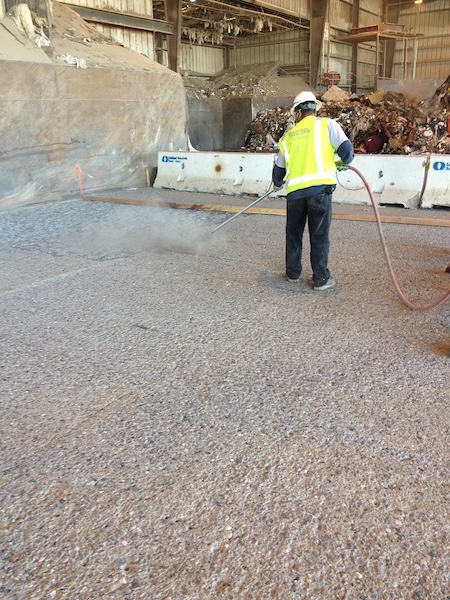
Fiber reinforcement reduces both the frequency and severity of shrinkage cracking. By distributing internal stresses more evenly, fibers limit crack formation and help keep any cracks that do develop tight and less likely to propagate. In fact, in many of these cases, crack widths can be reduced by more than 50 percent compared to conventional slabs.
When combined with the right mix design, such as water-to-cementitious material ratios in the range of 0.38 to 0.45 and the use of supplementary cementitious materials, the result is a denser, lower-permeability slab. This improved microstructure enhances resistance to moisture ingress and chemical exposure, which are critical factors in waste facility floor durability.
Designing for Impact, Abrasion and Continuous Loading
Impact loading is a defining characteristic of waste facility operations. Floors must withstand constant abuse from heavy equipment, dropped materials, and high-cycle loading. These forces create localized stress concentrations that can exceed the compressive strength of conventional concrete, leading to microfracturing, spalling, and surface degradation.
Fiber-reinforced concrete improves floor performance under these conditions by increasing the slab’s ability to absorb and dissipate energy. Fibers act as bridges across developing cracks, allowing the concrete to maintain integrity under repeated loading. This increased toughness reduces the likelihood of sudden failure and extends the usable life of the floor.
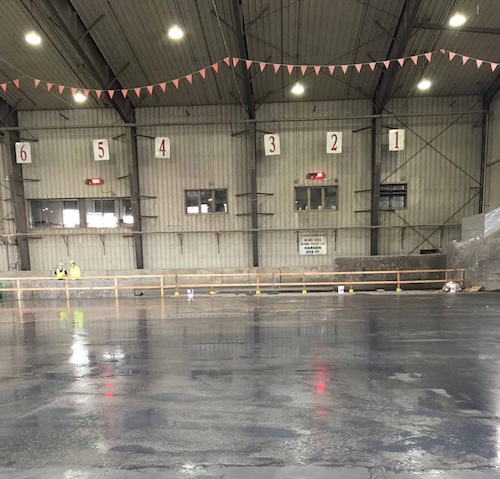
Synthetic macrofibers are increasingly specified due to their durability and resistance to corrosion, while steel fibers may be used in extreme impact zones where higher stiffness is required. In both cases, the goal is to create a concrete slab that can withstand the mechanical realities of waste facility operations without excessive maintenance or repair.
Creating a Stable Foundation for Surface Protection Systems
The long-term performance of any flooring system, waste environment or not, heavily depends on the quality and stability of the concrete substrate. Cracking, surface defects, and internal stress all contribute to premature deterioration if not properly controlled.
Fiber reinforcement contributes to a more uniform and durable surface by minimizing cracking and reducing the formation of weak zones. This stability is particularly critical in waste facilities where floors are exposed to aggressive cleaning practices, moisture cycling, and chemical attack.
A well-constructed, fiber-reinforced slab provides a reliable base for surface protection systems such as densifiers, sealers, or high-performance coatings when required. While these systems are extremely useful in enhancing abrasion resistance and limiting fluid penetration, ultimately their effectiveness is directly tied to the integrity of the concrete substrate beneath them.
Practical Considerations for Implementation
Integrating fiber reinforcement into a concrete flooring system requires careful coordination between mix design, placement, and finishing practices. The type and dosage of fiber must align with the performance requirements of the facility. Too little fiber may not deliver meaningful benefits, while excessive amounts can create workability and finishing challenges.
Concrete mixtures should be designed in a way that optimizes the durability of waste facility floors, including proper aggregate gradation and the use of supplementary cementitious materials to reduce permeability and improve long-term performance.
Equally important are the field practices that ensure the system performs as intended. Key factors to address include:
- Selecting the appropriate fiber type for the application
- Adjusting placement and finishing methods to account for fiber content
- Ensuring proper curing to achieve desired strength and durability
- Performing adequate surface preparation prior to applying any protective system
Fiber-reinforced concrete behaves differently during placement and finishing, requiring careful attention to consolidation and surface finishing techniques to achieve a smooth, durable surface. Proper curing is absolutely essential to control shrinkage and support strength development.
Surface preparation is also a critical step, especially with surface protection systems. Mechanical methods like shot blasting or grinding remove weak surface layers and ensure proper bonding. And while fiber reinforcement enhances the substrate, it doesn’t replace surface preparation.
Operational Benefits for Facility Managers
For facility managers, fiber-reinforced concrete floors offer both practical and measurable advantages. Reduced cracking leads to fewer maintenance issues and less disruption to operations. In facilities where uptime is critical, this directly benefits productivity and revenue.
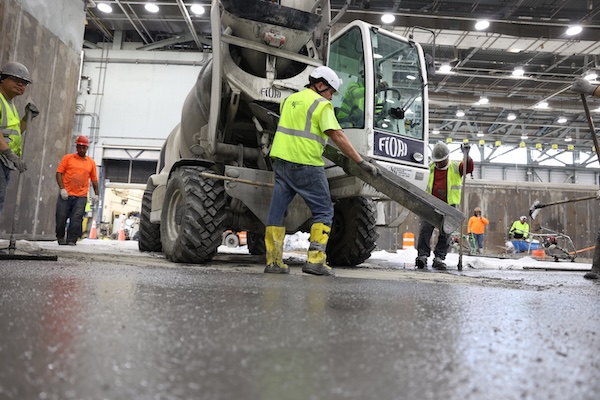
Maintenance costs are also lower. Concrete floors that maintain their integrity over time require fewer repairs and less frequent intervention. When issues do arise, they are typically smaller in scope and easier to address. This helps to reduce any downtime in a waste environment.
Safety is another important consideration. Floors that resist spalling and remain level reduce the risk of accidents for both personnel and equipment operators. In high-traffic environments like a waste facility, maintaining a consistent and durable surface is key to safe operation.
Plus, from a financial perspective, the initial investment in fiber reinforcement is often offset by longer service life and reduced lifecycle costs. For waste facilities planning long-term operations, this makes fiber-reinforced concrete a highly practical and cost-effective solution.
A Systems-Based Approach to Flooring Performance
As heavier equipment, increased throughput and more aggressive materials place greater demands on waste facility infrastructure, addressing these challenges requires facility operators to shift from traditional, prescriptive methods to performance-driven design.
Fiber reinforcement strengthens concrete from within, improving its ability to resist cracking, absorb impact and withstand harsh environmental conditions. When combined with the right design practices and construction techniques, it creates more resilient, longer-lasting floors.
The takeaway is clear: concrete floors in waste facilities should be viewed as integrated systems rather than isolated components. By aligning materials, design and execution, it is possible to deliver floors that meet both immediate operational needs and long-term performance goals.