
When we treat AI as an assistant rather than a replacement, we turn skeptical employees into empowered, productive partners.
By David Berg
The conversation around AI in waste management is stuck in the past, debating technical capability when the true challenge lies in workforce adoption and trust. For too long, frontline employees, from drivers to sales reps, have been treated as recipients of technology, not collaborators. The next phase of efficiency and profitability will not come purely from automation, but from a deliberate, human-centric AI implementation.
We must move beyond the basic question of “should we use AI?” and focus on creating systems that are simple, intuitive, and designed to amplify human expertise, not replace it. CEOs must prioritize workflow-specific tools that eliminate manual friction, deliver actionable intelligence in real-time, and, most critically, boost worker job satisfaction.
Building for the Person, Not the Process
To successfully shift the industry paradigm from automation to augmentation, we must fundamentally rethink our development philosophy. You cannot build a product in a vacuum and simply drop it onto a hauling team’s lap, expecting instant success. Genuine innovation requires a human-centric approach that prioritizes the person or customer you are building for.
This starts with a discovery period. Gone are the days of the build first, sell later mentality. They need to be replaced by immersing ourselves in the daily realities of our users. By working alongside customers during the build phase of a new product, you can understand exactly what makes them tick. The resulting tool becomes a perfect fit that solves real problems, rather than a forced adjustment that creates new ones.
A critical component of this human-centric design is addressing the fear behind AI head-on. In the waste industry, AI is often met with suspicion. Employees worry it will replace their roles or compromise their data. To overcome this, we should view AI implementation like a faucet, a utility where you can adjust the temperature to the organization’s comfort level. Rather than a sudden flood of change that overwhelms the staff, AI can be drip fed. This incremental approach allows the team to acclimate to the technology, see its benefits firsthand, and realize that AI is there to support them, not displace them.
We also must understand the “why” of the individual. Successful adoption hinges on knowing the specific motivations and hesitations of the workforce. Questions leaders can ask are:
- Am I spending time on things that I shouldn’t be?
- Do I feel behind at the end of the day? If work is overflowing, why?
- Am I hiring more people than expected because my current team is bogged down by manual tasks?
If leadership does not take the time to understand the person performing the task, they will never earn the trust necessary to integrate AI into the daily workflow. Trust is not built through a manual; it is built by proving that the technology understands and respects the user’s expertise.
The Path to Adoption: Start Small, Win Fast
The primary barrier to AI adoption in our industry is not just fear, but also the negative reputation created by clunky, manual, web-based tools that promised to make life easier but did not. Given this, we need to separate AI from the typical software experience. To encourage adoption, follow a low-risk, high-reward methodology:
- Identify the Hated Tasks: Start with the things people enjoy least like manual data entry. It is low-risk and high-friction. No one misses doing it, and it allows the team to see the time-saving benefits immediately.
- Sell Time and Money: AI’s biggest selling points are its ability to increase revenue or cut costs in a low-risk way. When an employee realizes they have two extra hours a day to focus on high-value tasks, the fear disappears.
By focusing on these low-risk wins, we do more than just clean up data or save a few hours; we begin to fundamentally reshape the employee’s relationship with their work.
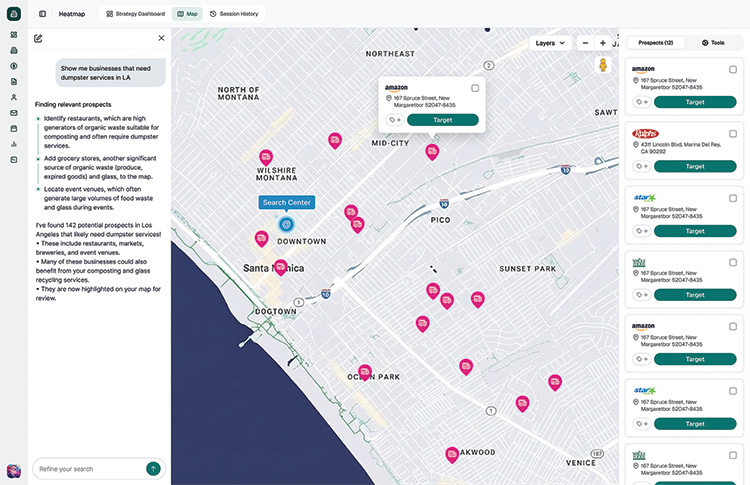
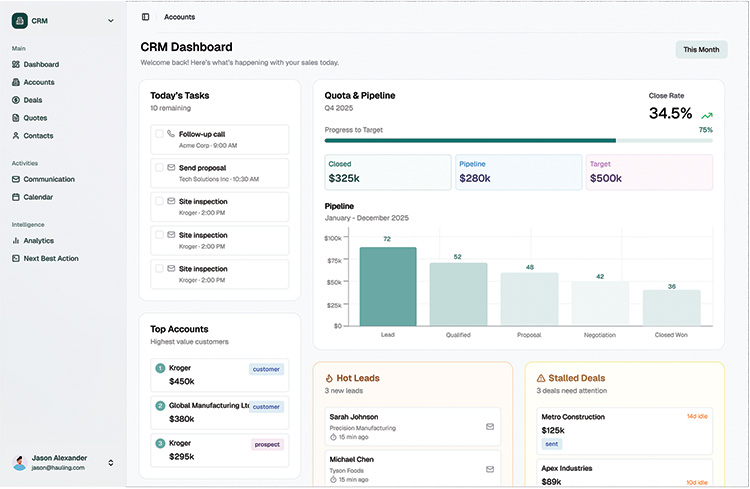
Images courtesy of CommanderAI.
Redefining Productivity through Human Connection
To me, worker satisfaction is tied directly to emotion. Frustration often stems from the gap between what we want to achieve and the time we have to do it. AI bridges that gap. AI is better than a human at crunching numbers or drafting initial cold e-mails, but creativity and human connection will never go away. People still want to deal with people. By offloading the robotic parts of a job to AI, we allow employee relations and customer service to remain human-centered.
We are seeing this shift across the industry. Some legacy players are cautiously dipping their toes in by automating back-office tasks, while new-age haulers are jumping in head-first, using AI as a competitive advantage to out-scale larger competitors with leaner teams.
For example, a South Florida roll-off company successfully transitioned from chasing cold leads and referrals to using real-time data to pinpoint active construction projects. This shift in mindset allowed them to convert nearly 27 percent of their targeted prospects within 60 days, driving a 20 to 30 percent boost in monthly revenue. Similarly, a mid-Atlantic hauling operation with 50 trucks integrated AI-driven permit analysis to cut lead qualification time in half, closing 12 major accounts in a single quarter. These results demonstrate that when teams “think with AI” to prioritize high-value opportunities and gain pipeline visibility, they do not just work faster, they also work with a level of precision that was previously impossible.
When we treat AI as an assistant rather than a replacement, we turn skeptical employees into empowered, productive partners. When employees “think with AI,” we can then ensure the long-term success of digital transformation in the waste hauling industry. | WA
David Berg is the CEO and Founder of CommanderAI, a company at the forefront of leveraging artificial intelligence to transform the waste management industry. Under his leadership, CommanderAI has raised more than $5 million in funding and grown to a team of 15+ employees serving customers across the U.S. and Canada. David’s vision is to revolutionize the industry by using AI to optimize sales operations, drive efficiencies, and solve complex business challenges. CommanderAI is actively preparing for its Series A round in 2026, positioning itself for long-term growth and market leadership. David can be reached at [email protected].