
The Baltimore City Department of Public Works (DPW) Bureau of Solid Waste doesn’t have the luxury of a slow day. The city runs roughly 90 percent rear loaders across its residential collection fleet, operates five drop-off recycling centers, manages its own landfill, and runs a transfer station staffed entirely by city employees. When something in that complex chain breaks down, the effects move through the whole system fast.
The transfer station sits at the center of that chain. Material comes in from collection routes, gets compacted, and loads into a fleet of around ten closed-top trailers for transport out of the facility. It’s a high-volume, time-sensitive operation, and it depends on the compactors running. Not most of the time, continuously.
What Gradual Failure Actually Looks Like
Several years ago, that’s exactly what stopped happening. Not through a single catastrophic failure, but through the kind of gradual deterioration that’s harder to respond to because each step down feels manageable until it isn’t. The compactor fleet had aged past its useful life. Maintenance had not kept pace. Multiple units were non-operational at the same time, which meant the remaining equipment was carrying a load it wasn’t designed to carry alone. Operators adapted the way experienced crews always do, they built workarounds. They figured out how to keep material moving despite the gaps. But workarounds have a cost. Cycle times stretched. Spillage became a routine condition rather than an exception. Congestion built up inside the building. The facility was still processing waste, but it was working significantly harder than it should have been, and the margin for anything else to go wrong had shrunk to almost zero.
For a public agency running city-wide residential collection, that margin matters. The Bureau of Solid Waste is responsible for service commitments that don’t pause because equipment is down. When throughput at the transfer station slows, the effects don’t stay inside the building. They work backward through the collection system and forward into how reliably the city can meet its obligations to residents.
Staying With What Works
DPW had been running Marathon compactors since around 2000. Over more than two decades, the facility itself had been configured around that equipment, the layout, the trailer interface, the operational flow. When it came time to replace the fleet, the case for switching to a different manufacturer would have required a strong argument, and there simply wasn’t one. The infrastructure was already there. The equipment had performed. The decision to stay with Marathon was less a brand preference than a practical assessment of what the building was already built around.
Procurement Doesn’t Have to Be the Bottleneck
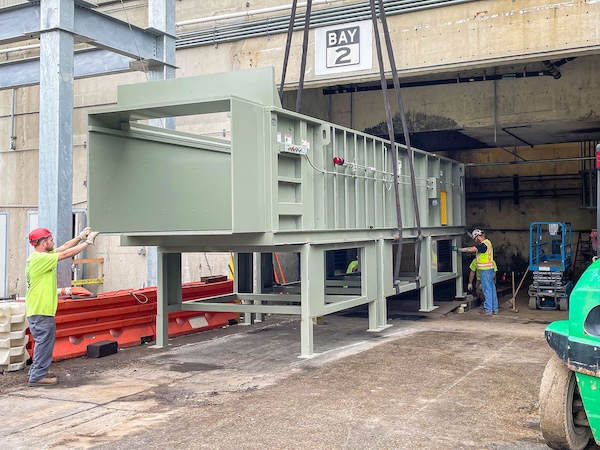
What made the replacement project move as quickly as it did was the procurement structure. The Bureau used a Sourcewell cooperative purchasing contract, which lets public agencies buy off a previously bid RFP that had over 20 participating respondents for equipment of this nature. For public agencies, procurement is often the longest part of any equipment project. Sourcewell simplified that significantly. Approvals that would typically require months of back-and-forth moved fast. Drawings and specifications came back on a timeline that matched the urgency of the situation rather than the pace of a standard municipal purchasing cycle. That alone made a huge difference for an operation that couldn’t afford to wait.
The Partner Question
The technical coordination ran in parallel with the procurement process rather than waiting for it to finish. Big Stuff, Marathon’s regional distributor and the Bureau’s primary point of contact on the ground, was engaged before the details were fully sorted and stayed that way through delivery. That early hands-on involvement set the tone for everything that followed. When backorder periods came up, as they do with equipment orders, the response wasn’t silence followed by a revised date. It was consistent updates on where things stood and what to expect next. That distinction gets underestimated in most equipment purchasing conversations. A public agency managing an operational crisis doesn’t need optimism. It needs accurate information and people who pick up the phone, every time.
What 25 Minutes Actually Means
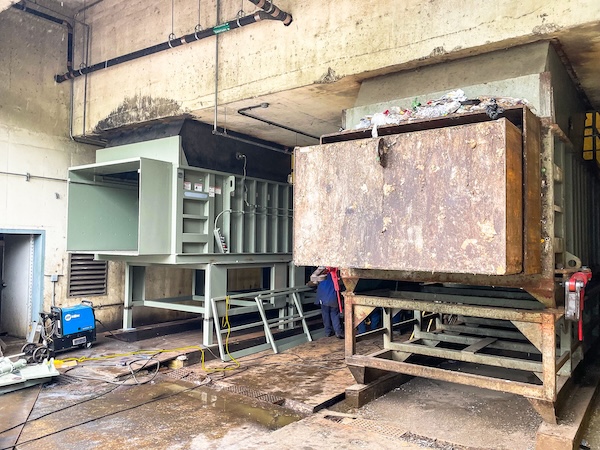
The three new Marathon M1475 compactors that came out of that process changed the operational picture in ways that were immediate and measurable. Cycle time dropped from around 45 minutes to around 20. That number was a big deal. Cutting processing time in half doesn’t just mean the same work gets done faster. It means the downstream effects compound exponentially across the whole facility. Trailers turn around faster. Congestion inside the building drops. Floor space that had been absorbed by backed-up material becomes available again. The spillage that had been a routine condition stopped being one. The workarounds that operators had been carrying as part of their daily routine stopped being necessary because the underlying problem was fixed rather than managed around.
Three compactors running, all of them operational and highly efficient. For a facility that had been limping along with partial capacity and the inefficiencies that come with it, that was the baseline restoration that everything else depended on. Full capacity isn’t simply a performance metric at a transfer station. It’s the condition under which the facility can do its job.
The Human Side of a Functional Facility
The workforce felt that change instantly. Operations that had required improvisation and extra handling steps became more predictable, and predictability matters more than it sounds like it should. Operators who had spent months stressfully managing around a system that wasn’t performing as designed could finally just do their jobs. Cleaner conditions, more available space, less exposure to loose material in congested areas. A functional facility is supposed to provide all of that. This one was again, and for a workforce that had spent years absorbing the daily grind of a system that fought against them at every turn, coming to work suddenly became something to look forward to instead of dread.
What It Actually Costs to Let Infrastructure Slide
There’s a point about public infrastructure that tends to get underweighted in how these purchases are discussed. Equipment that processes municipal solid waste isn’t discretionary. A city can manage a lot of operational variability, but it simply cannot consider not moving trash. When the equipment supporting that function degrades to the point where it’s affecting throughput, reliability, and workforce conditions, the cost spreads well beyond the facility budget line. It shows up in service consistency, in the strain on the people doing the work, and in the kind of improvised operations that create safety exposure over time. Restoring that capacity is better understood as reestablishing the conditions under which the work can be done correctly, and everything that depends on those conditions along with it.
A Relationship Worth Naming
The Bureau’s relationship with Big Stuff came up repeatedly in how they characterized the project, and with specific examples. The responsiveness and the relationship, in their words, is something they would share with anyone. That’s a meaningful thing to say. It reflects a real-world experience of a partner who showed up when the situation was difficult, communicated honestly through the parts that were uncertain, and followed through on what they said they would do. For a public agency navigating a procurement and installation process under operational pressure, that kind of partner is genuinely hard to come by, and the Bureau knows it.
Building From a Stable Foundation
The transfer station is now running the way it was designed to run, and the Bureau is thinking further out than the immediate operational picture. A composting facility is in development. A second transfer station is under consideration as the city’s long-term waste management needs evolve. Landfill capacity expansion is on the table. These are multi-year projects with their own complexity and their own procurement challenges, and they’re being planned from a more stable operational foundation than the one the Bureau was working from a few years ago.
That stability and forward vision isn’t separate from the equipment upgrade. It’s a product of it. A facility that’s managing operational failure doesn’t have much capacity to think about the next five years. One that’s running at full capacity, with equipment that performs and a distributor relationship built on demonstrated trust and reliability, can. The groundwork laid in a project like this one can seem minor against the scale of all that’s planned next, but it’s the foundation that everything else gets built on.
What Other Public Agencies Can Take From This
For other public agency operators working through similar situations, the City of Baltimore’s experience is something worth borrowing. Get the procurement structure right and approvals stop being the obstacle. Find a committed partner who communicates and follows through, and the supply chain delays stop being the crisis. Stay with a proven platform, and you’ve eliminated a whole category of risk before the project even starts. None of those decisions required reinventing anything.
Together, they kept a critical piece of public infrastructure from spending another year limping along. Cycle times cut in half. Three compactors running efficiently where broken equipment once sat. A workforce that dreaded coming in now has a facility that works for them instead of against them. A city that couldn’t reliably meet its service commitments can again, with ease. That’s the full picture of what a well-executed equipment project actually delivers, and Baltimore is a good example of what it looks like when everything comes together the right way.